
Most buyers are future buyers.
Ehrenberg-Bass uses a five-year B2B purchase cycle to illustrate about 5% entering the market per quarter. The report explicitly calls the ratio a heuristic.
Ehrenberg-Bass Institute ↗The Conduit Purchase Impact Map
The right media mix is prescribed by the business problem. No two businesses need the exact same formula. Conduit gives agencies a deep enough bench to choose the ingredients that fit the objective, instead of forcing every client into the channels an agency happens to keep in-house.
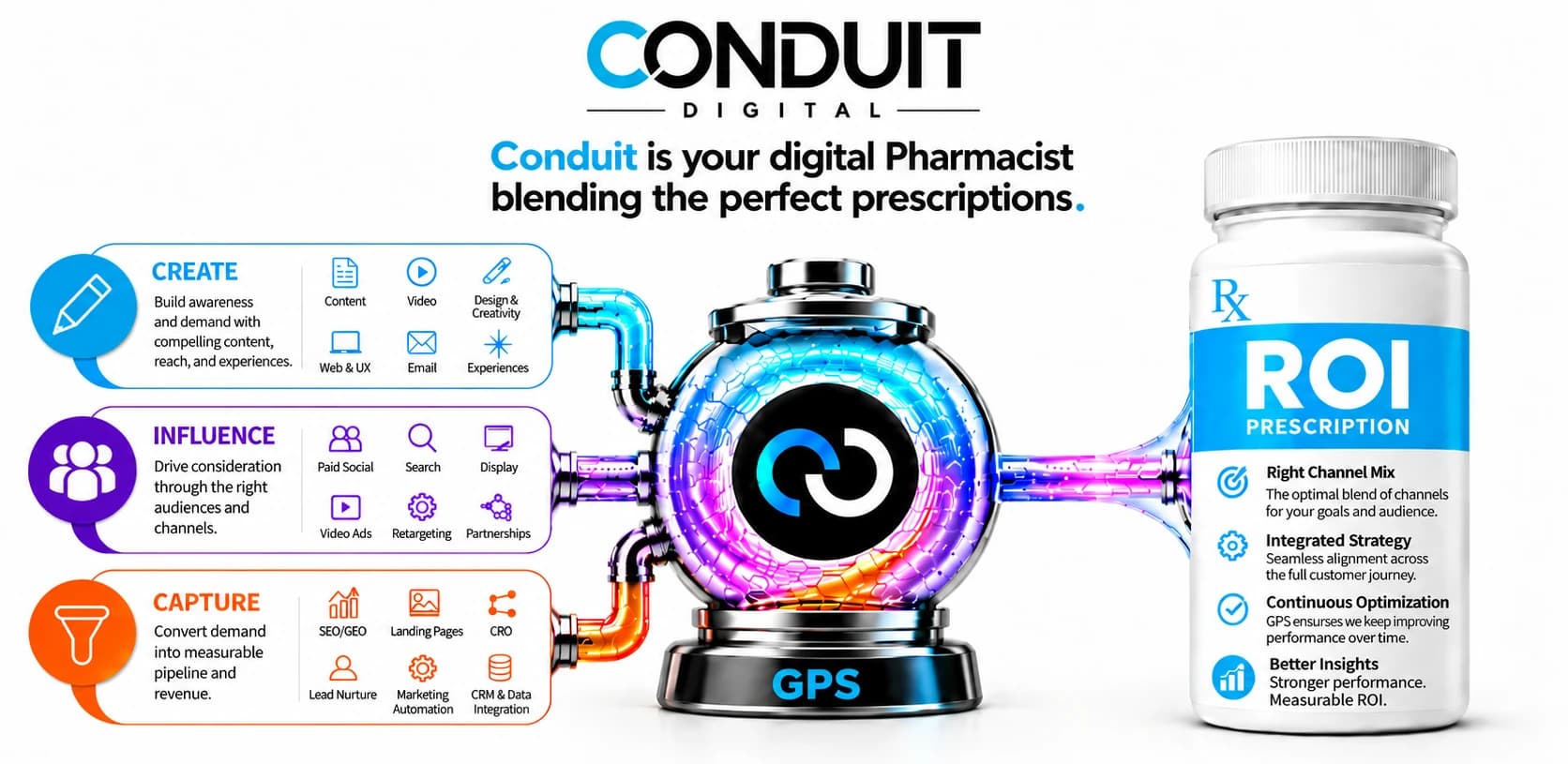
Think of Conduit as a digital pharmacist.We give agencies the breadth to prescribe the right mix across all three, then GPS measures, optimizes, and improves the outcome.
Browse the servicesNew Path to Purchase
Create DemandInfluence the DecisionCapture the Intent
The Conduit Purchase Impact Map explains why this matters. It replaces a fixed sequence with three durable media duties and shows how channels interact across Create, Influence, and Capture as buyers move toward purchase in less deliberate ways.
Why the path changed
Buyers carry memory, familiarity, proof, trust, and preference into the moments where intent becomes visible. CREATE and INFLUENCE shape those conditions before CAPTURE converts them, which is why the modern path to purchase must account for more than the final interaction.
WHY CREATE MATTERS
CREATE builds and refreshes brand memories with that future market. It links the brand to the needs and buying situations that can activate purchase later.
The 95-5 figure is a heuristic, not a precise law; the point is that most buyers you reach aren't ready to buy.
The future market is not wasted reach.It is tomorrow's demand.
Research basis: Ehrenberg-Bass 95:5 rule ↗Average purchase cycle: 3 years
Move the slider to see how the balance between future buyers and buyers entering the market changes.
In market this quarter: ~8%Future buyers: ~92%
WHY INFLUENCE MATTERS
Buyers do not arrive at CAPTURE with neutral minds. They bring familiarity, prior exposure, trust, recommendations, and an early shortlist. INFLUENCE turns recognition into relevance, confidence, and preference.
Brand Awareness is a purchase probability multiplier.
Research basis: Category Entry Points and Mental Availability ↗Familiarity lowers frictionThe buyer recognizes the brand faster.
Trust reduces riskThe decision feels safer and easier to defend.
Preference improves CaptureActive intent arrives with an existing predisposition.
Ehrenberg-Bass uses a five-year B2B purchase cycle to illustrate about 5% entering the market per quarter. The report explicitly calls the ratio a heuristic.
Ehrenberg-Bass Institute ↗Bain reports that 85% of B2B buyers purchase from their Day 1 list, meaning vendors they already had in mind before searching.
Bain & Company ↗In a Google and Kantar antivirus study, brand accounted for nearly one-third of the modeled final decision. This finding is category-specific.
Google and Kantar ↗Nielsen's experience base reports that, on average, a one-point gain in awareness or consideration is associated with a 1% increase in sales.
Nielsen ↗20+ Digital Products & Services · one connected system
The planning principle
Plan around the business behavior that must change, then choose the instruments best suited to change it.
A search click may capture intent that OOH, video, social proof, email, or AI visibility helped create. The Purchase Impact Map protects those upstream contributions while keeping every tactic accountable to ROI-oriented performance.
Placement is based on the capability's primary job. The strategic role profile shows where it also contributes, without turning an illustrative planning model into a false attribution score.
| CHANNEL | CREATE | INFLUENCE | CAPTURE |
|---|---|---|---|
| CTV / OTT | Primary job | Supporting role | No role |
| Paid Social | Supporting role | Primary job | Supporting role |
| Paid Search | No role | Supporting role | Primary job |
| AEO / GEO | No role | Primary job | Supporting role |
| OOH | Primary job | Supporting role | No role |
| Display | Primary job | Supporting role | Supporting role |
Plan by the behavior that must change.Then choose the instruments best suited to change it.
Create, Influence, CaptureBuild the plan from the business problem
The map turns a product menu into a planning conversation.
Increase reach, recognition, category entry points, and mental availability.
View Create capabilitiesEducate, demonstrate, build authority, answer objections, and create confidence.
View Influence capabilitiesIntercept explicit intent and remove friction between need and measurable action.
View Capture capabilitiesSupporting system
The Goal Performance System connects CREATE, INFLUENCE, and CAPTURE to the business outcome, giving agencies one performance lens across the path to purchase without turning every channel into a last-click tactic.

Agency leader questions
The traditional funnel often assumes buyers move sequentially from awareness to consideration to conversion. The Conduit Purchase Impact Map instead identifies three jobs media performs: CREATE builds future demand and brand memory, INFLUENCE builds relevance, trust, and preference, and CAPTURE converts active intent. Consumers can move between these states in many different ways, so Conduit assigns each tactic a primary purchase role without assuming a linear customer journey.
Creating demand builds brand memory and future purchase probability before a buyer expresses active intent. Capturing demand reaches consumers who are already signaling a need through behaviors such as searching, shopping, comparing, calling, or requesting information. Sustainable growth usually requires both.
Yes. The Purchase Impact Map assigns each capability a primary role for planning clarity, but most channels contribute across multiple roles. Meta advertising can create reach, influence preference, and drive conversions. Display can create awareness and later retarget interested users. Search can capture explicit demand while also influencing consideration.
Because most potential customers in many considered-purchase categories are future buyers rather than active buyers. CREATE helps a brand become recognizable, memorable, and associated with relevant buying situations before purchase intent becomes visible. When those buyers later enter the market, the brand has a greater probability of being recalled and considered.
Buyers do not arrive at search, retargeting, or conversion environments with neutral preferences. Prior exposure can affect which brands they remember, trust, consider, and prefer. CREATE and INFLUENCE help shape the demand that CAPTURE channels eventually convert, which is why brand building and performance marketing should be planned as complementary parts of one system.
When more buyers recognize and prefer a brand, they may search for it directly, respond more positively when they encounter it in search results, and enter the search environment with greater trust. Search then captures demand that previous media helped shape. This is why Conduit treats brand building and performance marketing as complementary disciplines.
Last-click attribution gives most or all credit to the final measurable interaction before conversion. That can favor channels such as paid search and retargeting while understating the contribution of media that created awareness, memory, consideration, or preference earlier. Conduit evaluates tactics according to the purchase job they were selected to perform and then examines how those roles contribute to overall business performance.
No. The same strategic principle applies to local businesses, regional advertisers, ecommerce companies, B2B organizations, and national brands. What changes is the scale, purchase cycle, media mix, and measurement approach.
It gives agencies a strategic framework for explaining why different media investments exist within the same plan. Instead of presenting clients with a disconnected list of channels, agencies can explain how each tactic creates future demand, influences buyer preference, captures active intent, and contributes to an integrated performance objective.
GPS, the Goal Performance System, is Conduit’s operating framework beneath CREATE, INFLUENCE, and CAPTURE. It establishes campaign goals, configures measurement, guides optimization, and creates reporting that evaluates each tactic according to its intended purchase role rather than applying one universal performance metric to every channel.
No. The right prescription depends on category maturity, purchase cycle, existing brand awareness, competitive intensity, available demand, geography, budget, and the business outcome the client needs to change. Conduit’s breadth lets agencies build the mix around the problem instead of forcing every client into the same limited set of tactics.
Google reviews from agency partners
I've had the pleasure of working with Conduit for nearly four years now and I can't say enough great things about them. Their expertise and client service are unmatched, and they're constantly releasing invaluable tools and resources that make agency owners lives easier.
 James Vetrano2626 Consulting
Working with Conduit feels like adding a stacked bench to your starting lineup. They make it easy to trust your clients are in good hands while you focus on the big picture. They’ve been growing and evolving ever since and never stop looking for ways to win. Highly recommend.
 Megan MillerHarbor Collective
My company has been working with Conduit Digital for well over a year now. I can truly say that their partnership continues to amaze me. If you are looking for the best of the best white label agency, you won't find anybody better.
 Brad SipesADS
As an Account Manager, I am grateful to have all my questions thoroughly answered so that I can also provide peace of mind to my clients. I look forward to every single call because the Conduit team is just that good and fun to work with. I'm looking forward to many years of partnership and growth!
 Gabriela KrawczykLittle Jack Marketing
Conduit is quite simply the best marketing partner our agency has had. They are attentive, communicative, helpful, and above all, they get results! Highly recommend them to any agency looking for a great partner!
 Tom McFaddenJacob Tyler
The Conduit Team is extremely professional and knowledgeable, going the extra mile to ensure clients are taken care of while maintaining a positive and growth-oriented mentality during collaboration. Great team!
 Katy ThomasBloom