Voice Search Never Took Over. Here's What Actually Replaced It.
Voice search's predicted takeover never happened. What did happen: AI-generated answers now reach billions of monthly searches. Here's what changed and how to rank.
Quick answer: Voice search never became the dominant way people search. What replaced it was AI-generated answers, Google's AI Overviews and AI Mode now reach billions of users monthly, and the tactics that get you cited there are nearly identical to what used to be called "voice SEO."
Back in 2019, a stat made the rounds that half of all searches would be spoken instead of typed by the following year. That never happened. What actually happened is more interesting, and it's the subject of this guide.
Notice the structure of the two paragraphs above: a direct, self-contained answer first, context and narrative second. That's not a stylistic choice, it's the exact pattern voice assistants and AI Overviews are built to extract from a page. This guide is going to teach you that technique in detail, and it's already showing you how it works before you've finished the intro.
This applies just as much to how you optimize for voice assistants directly as it does to the AI-powered answer engines that have absorbed much of what voice search once promised, work that increasingly falls under the same white label SEO discipline agencies already offer their clients.
Key Takeaways
An estimated 8.4 billion voice-enabled devices are active worldwide, and roughly 35% of Americans age 12+ now own a smart speaker.
The bigger shift is AI-generated answers: Google's AI Overviews reach 2.5 billion monthly users, and AI Mode passed 1 billion monthly active users within its first year.
Local search behavior backs this up directly, the share of consumers using AI tools for local business recommendations jumped from 6% to 45% in a single year.
Voice and AI answer optimization share the same core tactics: a direct answer first, then supporting detail, structured with schema markup.
Voice optimization was never really about voice. It was a preview of what AI-mediated search would demand from content everywhere.
Voice Assistants in 2026: Who's Winning and What Changed
Quick answer: Google Assistant leads U.S. voice assistant usage with roughly 92 million users, followed by Siri (~87 million) and Alexa (~77 million). Smart speaker ownership has plateaued at 35% of Americans, while Amazon's generative Alexa+, built on large language models, reached general availability in early 2026.
Smart speaker ownership itself has plateaued rather than exploded: Edison Research's Infinite Dial study puts U.S. ownership at 35% of Americans age 12 and older, about 101 million people, a figure that's hovered around one-third of the population for four straight years after its initial growth phase.
Here's how the major platforms actually work today:
Siri: Apple's assistant, increasingly powered by Apple Intelligence for on-device and cloud query handling
Alexa / Alexa+: Amazon's assistant, now running on large language models for the generative version
Google Assistant / Gemini: Google's voice layer, increasingly merged with Gemini for multi-step, conversational queries
In-car and wearable assistants: A growing share of voice queries now happen in contexts that have nothing to do with a phone or smart speaker at all
How Speech Recognition Turns a Spoken Query Into a Search Result
Quick answer: Voice search converts spoken audio into text using large, transformer-based speech recognition models, then runs that text through the same search ranking systems as a typed query. The concept hasn't changed in years, the accuracy of the models doing the converting has.
Speech recognition software captures the incoming sound wave and reconstructs the words spoken from it. Modern systems rely on large, transformer-based models trained on enormous volumes of speech data, a meaningful step up from the smaller neural networks used a decade ago. Once the audio becomes text, it runs through the same ranking systems as anything typed into a search bar.
That accuracy improvement is a big part of why voice has become viable for more than novelty use, including as an input method for AI chat assistants themselves, not just traditional search.
Our Take: Voice Search Didn't Fail, It Was Measuring the Wrong Thing
Quick answer: The failed prediction was never wrong about what people wanted, a single direct answer instead of ten links to sort through. It was wrong about the delivery mechanism. People weren't reluctant to get a synthesized answer; they were reluctant to say it out loud in public. Strip out the "spoken aloud" part, and the prediction basically came true.
Strip out the "spoken aloud" requirement, and the underlying demand voice search was chasing, a single synthesized answer instead of a results page, has arrived at a scale the original prediction never imagined. It just showed up through a keyboard and an AI-generated summary instead of a microphone. Google's AI Overviews alone now reach more than double the entire U.S. population every month.
There's a practical consequence to this for anyone still treating "voice SEO" as a niche specialty separate from everything else: it isn't one anymore. The tactics that used to be voice-specific, concise direct answers, clean structure, schema markup, an accessible reading level, are now just what good content looks like everywhere, because AI Overviews, AI Mode, and voice assistants are all drawing from the same underlying signals. Agencies that still silo "voice optimization" as its own line item are missing that it quietly became table stakes for the entire content strategy around a client's site, not a bolt-on service.
AI Overviews and AI Mode: The Search Layer Voice Search Predicted
Quick answer: Google's AI Overviews reach 2.5 billion monthly users across 200+ countries. AI Mode passed 1 billion monthly active users within a year of launch. Local search shows the same shift, AI tool usage for local business recommendations jumped from 6% to 45% in twelve months.
Google's AI Overviews, the AI-generated summaries that appear above traditional search results, reach over 2.5 billion monthly active users across more than 200 countries, according to Google's own I/O 2026 keynote. AI Mode, Google's more conversational, chat-style search experience, crossed 1 billion monthly active users within roughly a year of launch, with query volume more than doubling every quarter since.
Local search behavior shows the same pattern playing out in real time. BrightLocal's 2026 Local Consumer Review Survey found that the share of consumers using AI tools for local business recommendations jumped from just 6% the year before to 45% today, a shift that fast rarely happens in consumer search behavior.
This matters for optimization because AI Overviews and AI Mode behave a lot like voice results always did: they favor concise, well-structured, directly-answering content, and they draw heavily from pages with clean schema implementation.
What Actually Gets Cited: Ranking Factors for Voice and AI-Generated Answers
Quick answer: Four things correlate most with getting cited: leading with a direct answer, clean schema markup (especially Speakable), an accessible reading level, and underlying domain authority. None of these are voice-specific anymore, they're just what good content looks like now.
Lead With a Direct Answer, Not a Windup
Content that gets cited in voice results and AI-generated answers tends to answer the question directly, in plain language, near the top of the relevant section, not several sentences into a narrative lead-in.
Action: Open each major section with a direct one-to-two sentence answer before expanding into supporting detail.
Schema Markup Still Matters, Just Not the Way It Used To
Structured data continues to correlate with voice and AI citation, even though its role in classic search results has shifted. FAQ and HowTo markup no longer produce the visible rich-result snippets they once did in standard Google Search, but the underlying markup is still used for page understanding, and Speakable schema, which flags the most citable passage in a page, has taken on new relevance specifically for AI Mode's source selection.
Action: Keep your existing Article and FAQPage markup in place even though the visible snippet is gone, and add Speakable schema to your most important content.
Write for a Ninth-Grade Reading Level, Not a Trade Publication
Content organized with clear headers, bullet points, and tables, written in accessible language, continues to perform well for both voice assistants and AI-generated summaries.
Action: Cut unnecessary jargon. Use lists and tables anywhere information is naturally structured that way.
Domain Authority Is Still the Gatekeeper
Higher-authority domains and well-established content still show up disproportionately often in voice and AI-generated answers, because these systems continue to use underlying search rankings as an upstream filter before selecting what to cite.
Action: Traditional authority-building, backlinks, consistent publishing, topical depth, hasn't gone anywhere. AI answer engines add a citation layer on top of classic SEO fundamentals; they don't replace them.
Why Local Voice and AI Search Queries Convert So Fast
Quick answer: Local voice and AI search queries convert unusually fast, often into a same-day call, visit, or purchase, because the intent behind a spoken "near me" query is almost always immediate.
Local businesses should treat voice and AI search optimization as inseparable from standard local SEO: accurate business listings, structured location data, and content that directly answers "near me"-style questions all feed the same systems voice assistants and AI Overviews draw from. This is exactly the kind of groundwork a true agency partner builds into a client's foundation before layering paid or organic campaigns on top.
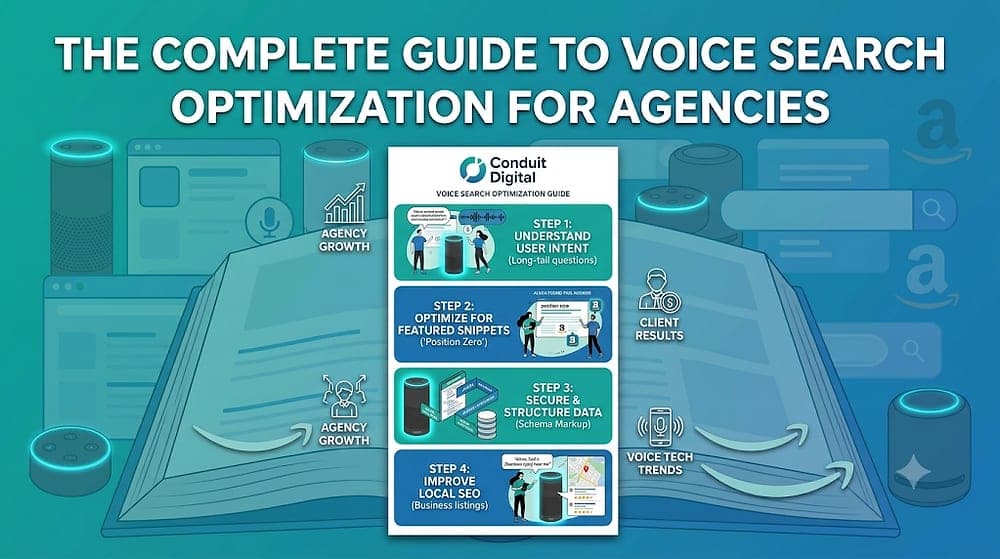
A Four-Step Checklist for Optimizing Content for Voice and AI Search
Quick answer: Add direct Q&A content, use lists and tables, implement Speakable schema alongside your existing markup, and write for topical depth instead of keyword density.
Add direct Q&A content. Structure key pages around the questions your audience actually asks.
Use lists and tables wherever content is naturally structured that way.
Implement structured data, including Speakable schema. Keep existing markup in place even where the visible rich result has disappeared.
Write for topical depth, not just keyword density.
Frequently Asked Questions About Voice and AI Search Optimization
Is voice search still relevant in 2026?
Yes. Roughly 8.4 billion voice-enabled devices are active worldwide, and voice remains a meaningful input method for smart speakers and AI chat assistants alike. Its biggest impact now is feeding the same conversational, direct-answer behavior powering AI Overviews and AI Mode.
What's the difference between optimizing for voice search and optimizing for AI Overviews?
Almost none. Both favor concise, directly-answering content, clear structure, and clean schema markup. The only real difference is delivery, one is spoken aloud, one is displayed as text. The content strategy is identical.
Does FAQ schema still help with voice and AI search?
Yes, indirectly. FAQ schema no longer triggers a visible rich-result snippet in Google Search, but the markup is still read for page understanding. Pair it with Speakable schema for a stronger AI Mode citation signal.
How do I optimize my business for local voice search?
Keep business listings accurate and consistent, add structured location data, and write content that directly answers "near me"-style questions. These signals feed voice assistants, AI Overviews, and standard local search simultaneously.
Will AI Overviews and AI Mode eventually replace typed search entirely?
No, current adoption data shows them growing alongside traditional search, not replacing it. Voice search followed the same pattern: it became a real, permanent channel without ever fully displacing typing.
The Answer You Could Have Skipped To
Voice search never became the dominant interface some once predicted, but the underlying shift toward conversational, direct-answer search was real, and it's arrived in a different form: AI-powered answer engines now reaching billions of users every month. Read this article again, and you'll notice every section opened with the answer before the explanation. That's not an accident, it's the whole point.